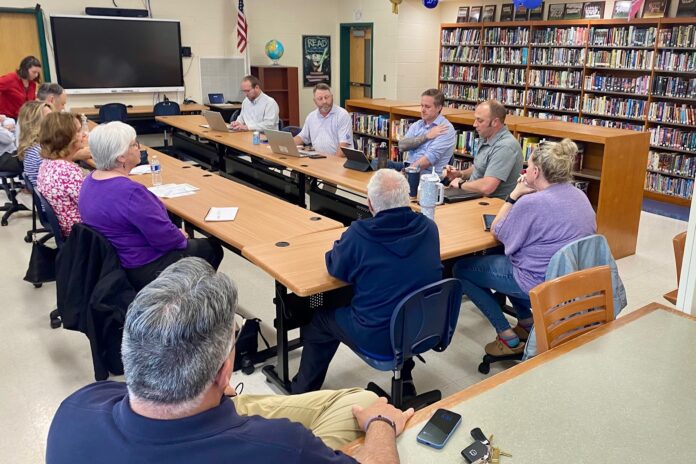
Lee — Meeting jointly on June 10, the town Finance and School committee members began to tackle a plan for future education budgets that aims to bring long-term success to the district and its students.
“Honestly, where we’re coming from, is if we can have some discussion about a school and a town that’s trying to help make new solutions for the future of this school,” Finance Committee Chair Susan Kelley said at the start of the session. “We’re concerned, as a Finance Committee, about that we’d like to see a plan in place that maybe will help us to see that it’s not just every year [the School Committee is] coming back with larger increases.”
With repeated requests for the school district to cut costs year after year, Kelley said the goal of the meeting was to brainstorm for a long-term solution. The school budget posted a five percent increase this fiscal year.
For Finance Committee member Bob Cohen, the issue stems from decreasing enrollment and population leading to an increase in district costs for insurance and salaries.
Some ideas discussed include adding an agriculture department or a specialty sports club to the district to draw students from all over Berkshire County to the unique program offered by Lee. Another comment involved the district featuring a pre-kindergarten initiative that, for Town Administrator Christopher Brittain, might be an incentive to keep children in the district throughout their educational career instead of transferring away due to a program not offered in Lee or for the convenience of the parent’s commute. Robotics and plumbing programs were identified to possibly draw added enrollment and, subsequently, revenue, as well as charging for outside groups to use district spaces, such as the gymnasium.
Lee Public Schools Superintendent Michael Richard noted that some of the programs require the district invest in hiring a teacher and fund other costs, not knowing whether the program will “get off the ground.” Although he said the District’s strategic plan will be reviewed next year, Finance Committee members asked what processes are in place this year for “anything that would decrease costs so that we don’t end up back in the same place we were this past year.”
Lee School Committee Vice Chair Kirk Nichols said the system lost two interventionist positions to limit the recent budget increase to only five percent, staffers “we could not afford to lose.” He added that the paraprofessionals in the classroom are paid the same as fast food workers at McDonald’s and Starbucks.
Kelley responded that the group wasn’t asking the district to decrease costs but to increase revenue that would offset the costs, with School Committee member Craig Langlois voicing concern over discussing the school system “from a revenue-generating standpoint.”
“We are responsible to the taxpayers,” Kelley said, with Langlois reiterating, “so are we.”
With some residents on fixed income and the school district budget making up a large portion of the town of Lee’s tax bills, Kelley said it is the Finance Committee’s fiduciary responsibility to have a long-term plan in place. “I agree with you 100 percent,” Kelley said. “Nobody gets paid enough what it costs to teach students today. I’m 100 percent in that ballpark, so how can we turn this around and make money so the school doesn’t have to come up with huge increases every year.”
School Committee Chair Andrea Larmon said she was mindful of the costs of liability and insurance for some programs, including an agriculture program, and proposed polling the students to identify what topics they would be interested in as a school offering. For Kelley, today, trade jobs seem to be important to students, such as a program dedicated to plumbing skills.
Long term, the town’s master plan shows a decrease in student enrollment over the next decade, to 449 students, explained Finance Committee member Sandra Dignard. “If we continue with a four percent increase each year, you’re looking at a $15.9 million budget. Not sustainable,” she said.
Richard cautioned that negotiations for district employees have already begun and may increase its costs and budget when the final settlement number is ascertained. He urged members to submit ideas or questions related to the revenue issue to find “real, meaningful solutions.”
For Cohen, finding a resource the district could offer that is not being provided in Berkshire County schools currently would be a pathway to generate revenue and add enrollment. He said the Finance Committee would support that project with “some seed money.”
“You’ve got a great system but it’s expensive for a small town,” Cohen said. “I’ve been hearing from other towns of what they’re cutting, and it’s not pretty. We’re still in a lot better shape than what I’ve heard from other places. So rather than letting it get anything close to that state, we want to figure out how do we keep moving forward.”