

This week’s column was inspired by an unsigned letter I recently received. The sender wrote this:
I’m a regular reader named Dick.
I enjoy that your writing is slick.
But for keeping your column
From getting too solemn
Some limericks might do the trick.
OK, Dick Whoever. You’ve caught my attention, and I’m happy to oblige.
I love the limerick, and it’s about the happiest verse form there is.
* * *
For many of us, the first poems we ever heard were nursery limericks recited over the cradle. Such as:
Hickory, dickory, dock,
The mouse ran up the clock.
The clock struck one,
The mouse ran down,
Hickory, dickory dock.
One or two years later we might have been regaled with:
What are little boys made of?
What are little boys made of?
Snips and snails
And puppy-dogs’ tails,
That’s what little boys are made of.
What are little girls made of?
What are little girls made of?
Sugar and spice
And everything nice,
That’s what little girls are made of.
* * *
So what exactly is a limerick and where did it come from. Well, to start, there is no known connection with Limerick in Ireland, a lovely city on the River Shannon, though the limerick in full flight certainly reflects the Irish sense of humor. Let’s just say that the city with or without poetry is worth a visit.

As for the verse form of the limerick, it is a poem of five lines, no more or no less, with a rhyme scheme of a-a-b-b-a. That is, the first, second and last lines are rhymed; they have three accent beats. The third and fourth lines, which are shorter, offer a different rhyme and have two accent beats. That’s it.
* * *
The great popularizer of the limerick was a landscape artist and poet named Edward Lear (1812-1888) whose Book of Nonsense contained over a hundred limericks with pen and ink drawings brightening the presentation. Here are two examples.
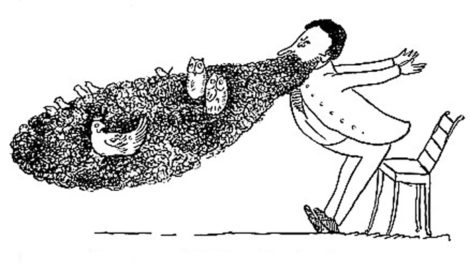
There was an Old Man with a beard,
Who said, “It is just as I feared! —
Two Owls and a Hen,
Four Larks and a Wren.
Have all built their nests in my beard!”
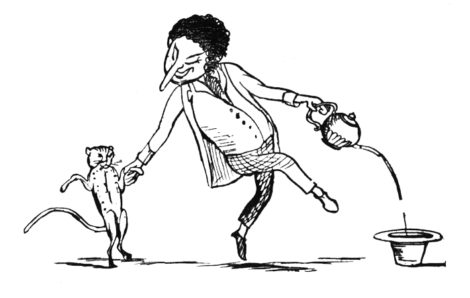
There was an Old Man on the Border,
Who lived in the utmost disorder;
He danced with the Cat,
And made tea in his Hat,
Which vexed all the folks on the Border.
Lear’s limericks followed a pattern of having the last line of the limerick repeat or echo the first line. Later writers have used the last line as a punchline, usually with a surprise comedic twist. Thus:
A wonderful bird is the pelican,
His bill can hold more than his belican.
He can take in his beak
Food enough for a week
But I’m damned if I see how the helican.
* * *
Sooner or later, almost everyone wants a go at writing a limerick. Here are a few from people you’ve heard of.
Rudyard Kipling
There was a small boy of Quebec,
Who was buried in snow to his neck;
When they said. “Are you friz?”
He replied, “Yes, I is—
But we don’t call this cold in Quebec.”
Robert Louis Stevenson
There was an old man of the Cape,
Who made himself garments of crepe.
When asked, “Do they tear?”
He replied, “Here and there.
But they’re perfectly splendid for shape.”
Oliver Wendell Holmes (This is a favorite of mine)
The Reverend Henry Ward Beecher
Called a hen a most elegant creature.
The hen, pleased with that,
Laid an egg in his hat.
And thus did the hen reward Beecher.
W.H. Auden
T.S. Eliot is quite at a loss
When clubwomen bustle across
At literary teas,
Crying “What, if you please,
Did you mean by The Mill on the Floss?”
Woodrow Wilson (Really!)
I sat next to the Duchess at tea;
It was just as I feared it would be:
Her rumblings abdominal
Were truly phenomenal,
And everyone thought it was me!
Ogden Nash (Of course)
A crusader’s wife slipped from the garrison
And had an affair with a Saracen;
She was not oversexed,
Or jealous, or vexed,
She just wanted to make a comparison.
Sir Salman Rushdie
The marriage of poor Kim Kardashian
Was krushed like a kar in a krashian.
Her Kris kried, ‘Not fair!
Why kan’t I keep my share?’
But Kardashian fell klean outa fashian.
* * *
There’s one important characteristic of limericks that should be noted early on. They are devilishly difficult to forget. With only the smallest hint they can leap to mind and color a serious occasion with silliness. For me, seeing a fine Greek statue of Zeus jump-started a limerick that wouldn’t leave me alone.
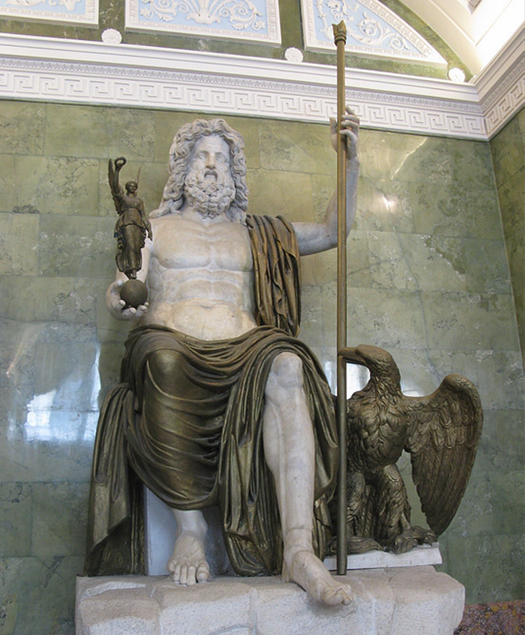
Upon high Olympus, great Zeus
Muttered angrily, “Oh, what the deuce!
It takes spiced ambrosia
To get the nymphs cozier
And Hera supplies grapefruit juice!”
* * *
I think we all know the limerick’s reputation for off-color humor. In fact, George Bernard Shaw claimed that true limericks had to be obscene. And Morris Bishop, distinguished professor at Cornell and limerick specialist, said:
The limerick is furtive and mean;
You must keep her in close quarantine,
Or she sneaks to the slums
And promptly becomes
Disorderly, drunk and obscene.
Now, this column is not going to stray into those murky waters. Let me just say by way of advice, beware of any limerick with the opening line:
“There once was a man from Nantucket.”
Still and all, a little risqué is surely okay. This gem is from the distinguished English poet Algernon Charles Swinburne (1837-1909):
There was a young lady of Norway
Who hung by her toes in a doorway.
She said to her beau
“Just look at me Joe,
I think I’ve discovered one more way.”
* * *
Finally, can you turn the tables and make fun of the limerick itself? Well,
W.S. Gilbert of Gilbert & Sullivan was for his time the ultimate master of rhyme. So what did he do with the limerick? He wrote one with no rhymes at all. I love it!
There was an old man of St. Bees,
Who was stung in the arm by a wasp.
When asked, “Does it hurt?”
He replied, “No, it doesn’t.
I’m so glad that it wasn’t a hornet.”
* * *
We started this column with a letter received, and I’m just shameless enough to close with another. This is from my favorite cellist and musical presenter, Yehuda Hanani of Close Encounters With Music. Somehow between concerts he finds time to dash off delightful limericks.
A brilliant composer named Perry
Cherished his whiskey and sherry.
Out of pure passion
He married a Russian
And his music turned jolly and merry.
To which I would respond:
There is a remarkable fellow,
The best in the world on the cello.
And in his spare time
He does wonders with rhyme.
Writing poems both martial and mellow.
And by the way, there’ll be a wonderful concert of Beethoven Trios with Yehuda Hanani this afternoon (December 11) at the Mahaiwe Performing Arts Center at 4:00.
* * *
VIDEO. Now let’s turn loose the First Poetry Quartet and guest George Plimpton as in a recital setting they present a rollicking collection of limericks.
CLICK ON THIS LINK FOR VIDEO: TAKE FIVE!