Editor’s note: Besides tracking technological advancements and innovations, our author is a Juilliard-trained musical composer. Listen to “Beyond Batch”, an original extemporaneous improvisation by Howard Lieberman, composed for this column.
This is Part 3 of a series of articles about how our educational system can and will change. You can read Part 1 here, and Part 2 here.
Modern educational systems were designed for an industrial world that valued synchronization, standardization, and scalable delivery of information. That architecture made sense when knowledge was scarce, and human attention was limited. But as society shifts toward a rapidly evolving, knowledge-driven environment, the assumptions underlying batch-processing education are increasingly misaligned with how people actually learn and how adaptation now occurs. New technologies, particularly AI-driven systems, are enabling more personalized, nonlinear forms of development while preserving guidance, coherence, and shared learning. What is emerging is not simply a new educational toolset, but a fundamentally different architecture of learning built around adaptability, interaction, and continuous exploration rather than rigid synchronization.
The industrial logic behind modern education
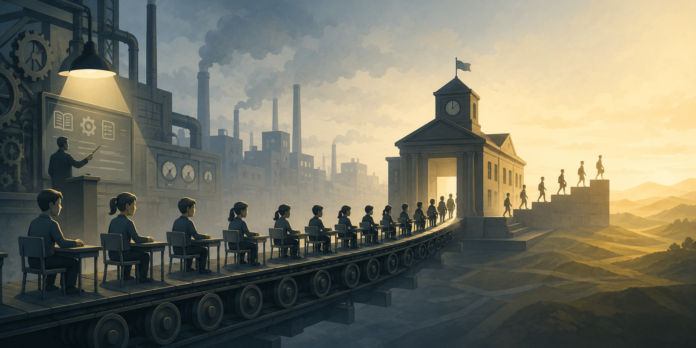
One reason educational systems are so difficult to change is that most people assume the current model emerged as the best way to help people learn. In reality, much of modern education was shaped by the technological and economic constraints of an earlier era. That structure made sense for the world in which it was created. The problem is that the world changed while much of that structure has remained.
The industrial age required systems that could operate at scale with consistency and predictability. Factories, bureaucracies, transportation systems, and mass production all depended upon synchronization, standardization, and coordination across large groups of people. Education evolved in parallel with those needs. Students were grouped by age, moved through material in fixed sequences, evaluated against standardized benchmarks, and advanced together through predefined stages. The system was designed less as an individualized developmental environment and more as a scalable social infrastructure.
That approach solved a real problem. When information was relatively scarce and highly centralized, it was efficient to gather people together physically and distribute knowledge in batches. One teacher could reach many students simultaneously. A standardized curriculum created consistency. Fixed pacing made administration manageable. The model scaled and, because it scaled, it became deeply embedded in society.
But scalability always comes with tradeoffs. The batch-processing model assumes that synchronization is more important than personalization. It assumes that moving people together efficiently is preferable to allowing them to move differently. It assumes that standardization creates fairness, even if it suppresses variation. Most importantly, it assumes that learning itself is relatively linear, progressing through predictable stages in roughly the same sequence for most people.
Human learning is far more nonlinear than the system assumes
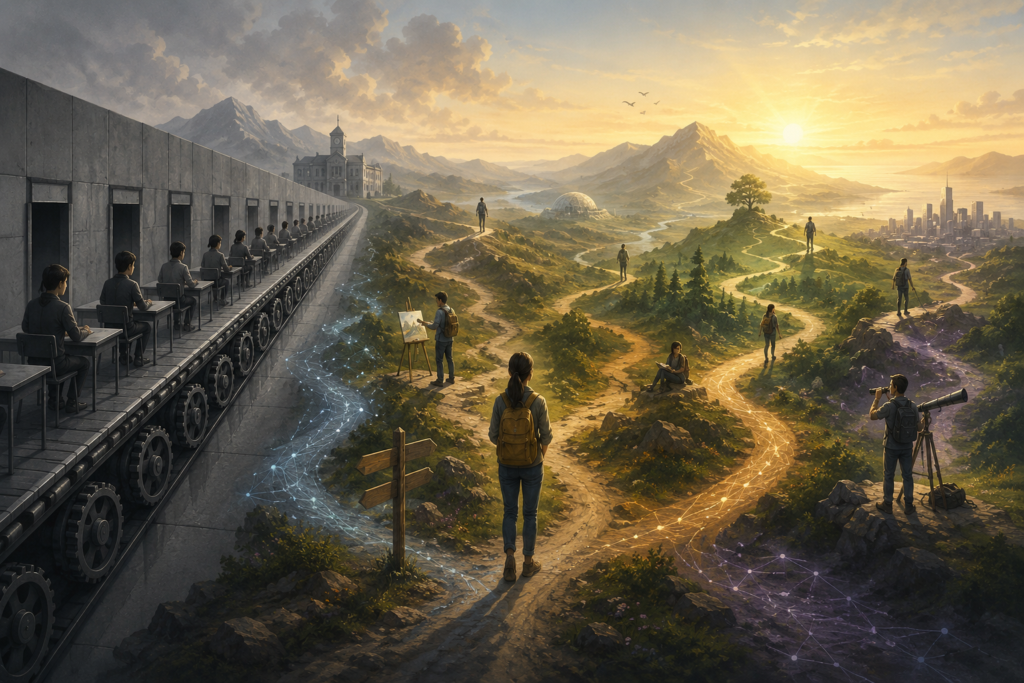
Anyone who has actually spent time learning complex things knows that this is only partially true. Human development is rarely synchronized. Some people grasp abstract concepts quickly but struggle with implementation. Others require time to absorb ideas, but later develop unusual depth. Some learners advance in nonlinear bursts, appearing stagnant for long periods before suddenly integrating concepts at a high level. Others learn best by wandering across disciplines and discovering unexpected connections. The industrial model treats these variances as inefficiencies because the system itself was optimized for coordinated movement rather than adaptive exploration. That mismatch becomes increasingly visible in a knowledge-driven world.
Today, the economic value of simply memorizing information continues to decline because information itself has become widely accessible. What matters more now is the ability to navigate complexity, synthesize across domains, adapt to changing conditions, and continue learning over long periods. These are fundamentally different capabilities from those emphasized by industrial-era systems.
The problem is not merely that educational institutions have become outdated. The deeper issue is that the system’s architecture reflects assumptions that no longer align with the environment students are entering. In a stable industrial system, predictability was an advantage. In a rapidly changing knowledge environment, adaptability becomes more important. The challenge is no longer simply absorbing predefined material. The challenge is developing orientation within an evolving landscape.
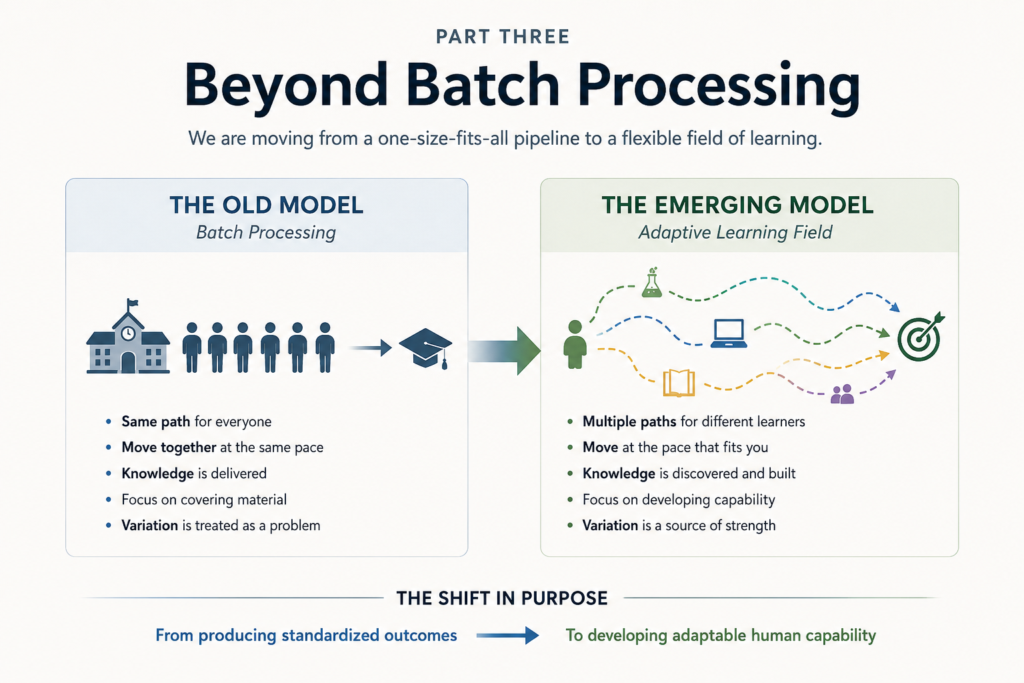
That requires a different model. Instead of functioning like a pipeline, learning increasingly resembles a field. In a pipeline, everyone moves through the same stages in the same order at roughly the same pace. Progress is defined primarily by advancement through sequence. In a field, multiple paths are possible simultaneously. Learners enter from different directions, explore different regions, and develop different kinds of depth based on their interests, capabilities, and experiences.
From standardization to adaptive learning fields
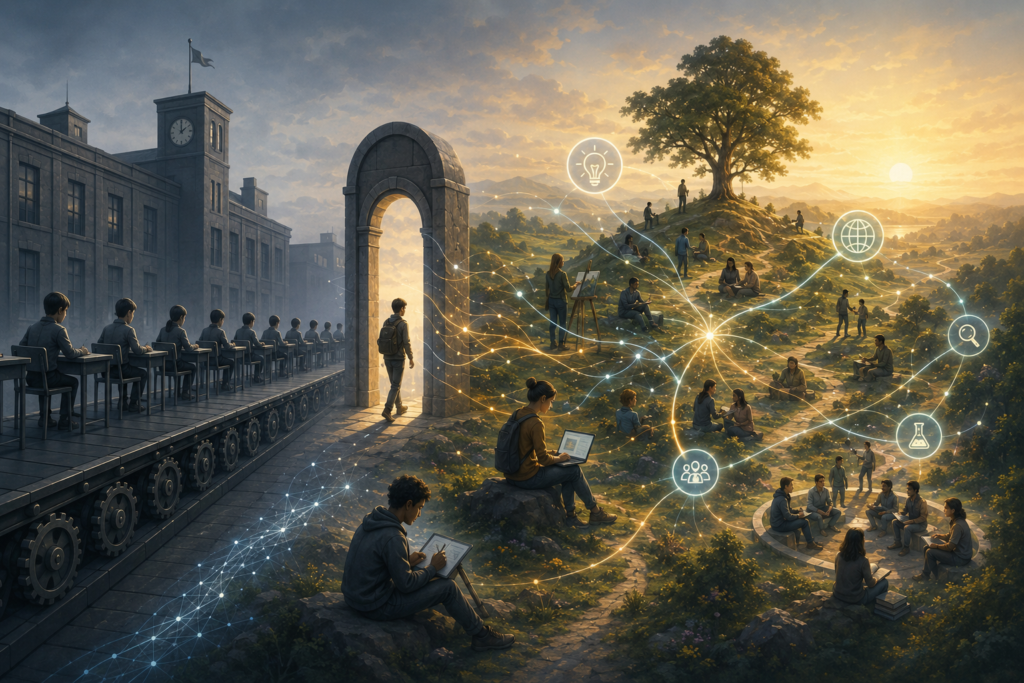
This does not eliminate structure. It changes where structure lives. In the industrial model, structure is imposed externally through synchronized pacing, rigid sequencing, and standardized progression. In a more adaptive system, structure emerges through interaction. Guidance becomes dynamic rather than fixed. Learning pathways evolve based on feedback, context, and development rather than remaining identical for everyone.
Technology is one of the forces making this transition possible. AI systems can now support individualized interaction at a scale that was previously impossible. Learners no longer need to remain synchronized simply because human attention is limited. A student can spend additional time exploring one concept while accelerating through another. They can revisit material repeatedly, ask questions continuously, and approach ideas from multiple angles without forcing the entire group to stop or advance together.
This does not mean structure disappears or that everything becomes unbounded exploration. In fact, the opposite may be true. As systems become more flexible, the need for meaningful guidance increases. Learners still require coherence, direction, and perspective. They still benefit from shared experiences and collective exploration. But those elements no longer require the rigid synchronization that industrial systems once did.
What begins to emerge instead is a hybrid model that combines personalization and coordination. Learners follow individualized trajectories while remaining connected to broader communities of inquiry and development. The role of the guide becomes helping individuals maintain orientation within this larger field rather than simply moving everyone through the same sequence. This also changes how variation itself is perceived.
In industrial systems, variability is often treated as a problem because it disrupts synchronization. In adaptive systems, variability becomes a source of resilience and innovation. Different trajectories generate different insights. Diverse approaches create richer forms of collective intelligence. The system becomes less fragile because it no longer depends on everyone moving in the same way. This represents more than a technological shift. It represents a philosophical one. The industrial model implicitly assumes that the purpose of education is to produce standardized outcomes efficiently. A knowledge-age model increasingly assumes that its purpose is to develop adaptive human capability in complex, changing environments. Those are very different objectives, and they produce very different systems.
What we are witnessing now is not simply the introduction of new educational tools. We are watching the early stages of a transition between two fundamentally different learning architectures. One was optimized for the needs of industrial society. The other is beginning to emerge in response to the realities of a networked, knowledge-driven world.
The old model was built around synchronization, standardization, and access scarcity. The emerging model is increasingly shaped by personalization, adaptability, continuous interaction, and distributed access to knowledge. The challenge now is not whether technology can support this transition. Increasingly, it can.
The real question is whether institutions designed around batch processing can evolve quickly enough to support a fundamentally different understanding of how human learning actually works.