
1894
Once Stockbridge was second—by that proverbial country mile—to Lenox. True. In an 1894 article in Scribner’s Magazine simply titled “Lenox,” George Hibbard dubbed Lenox “a place where society gathers.” Stockbridge wasn’t even mentioned, relegated to that place next door.
In 1952, in his book “The Last Resorts,” Cleveland Amory wrote, “Every Lenox has its Stockbridge,” meaning the place for the hangers-on, not the elite. Ouch! Did Stockbridge mind? Nope.
When Lenox claimed that Tanglewood, Elm Court, Highwood, and Wheatleigh were in Lenox, Stockbridge knew better and stood mute. Why? In the 19th century as Lenox was changing from a farming community to a resort, in the 20th century as the elegance of the grounds at Erskine Park in Lenox were overrun with condos, in the 21st century when the spectacular views and sweeping grounds of Wyndhurst were swallowed by bungalows built cheek-by-jowl, Stockbridge was largely unchanged.
2019
During COVID and the flight to safety, the largely unchanged, sparsely populated village of Stockbridge was just what the doctor ordered. Houses sold in minutes. Bidding wars jacked up the prices to astonishing heights. Unprepossessing cabins on the lake were torn down and bigger, better lake houses built. Forty years ago, I built my house for $47,000. In 2019 and after, folks came knocking on my door offering $1 million.
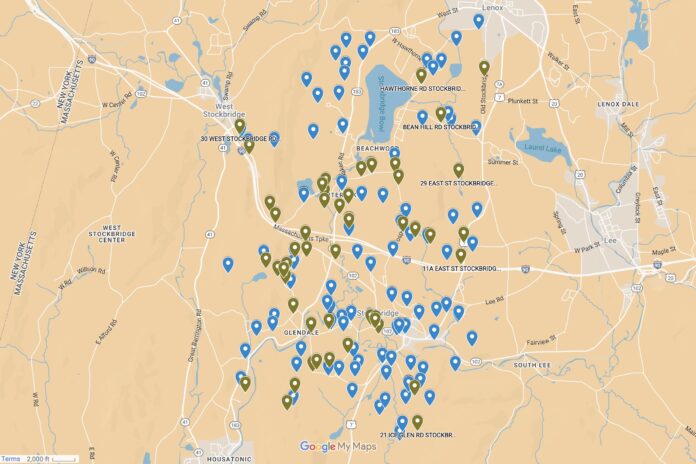
How did Stockbridge feel then? Vulnerable. The enormous rise in Stockbridge property values created the margin necessary for profitable development. Any open land in Stockbridge is vulnerable to development, and there is an overwhelming amount. (See map above with tracts of more than 20 acres in blue and tracts in Chapter 61 in the attached list.)
The conundrum
There is not one answer. Read on and two arguments will be made: to negotiate with developers and to put our collective foot down. Which is it? Both. The devil is in the details, and the details are exhaustive. Besides, there are two entirely different circumstances: when negotiation is possible and when it is not.
When Negotiation is possible — The permitting process
Development is a dilemma. Profitability is linked to density. The more a developer builds the more they make. Between a developer who proposes density and the neighbors who propose building nothing is acceptable growth.
It is a dilemma that can only be resolved through reasonable negotiation. When a developer applies for a special permit, negotiation begins. The Permitting Authority for the town must be strategic, savvy, and calm. How they work it out will shape our town.
Probably the last thing needed is a politician who states, “If elected, I will vote against the development being negotiated right now.” Yikes! We lose all power to negotiate if we tip our hand. Moreover, if an elected official with the power to decide blurts out a position, the town is no further ahead, but the developer is.
If the developer knows they will be turned down by one member of the permitting authority, that is the ballgame. The vote must be unanimous; one “no” vote is a veto. The developer is not without choices. The developer can withdraw their application and subdivide rather than develop. Subdivision is by right. There is no negotiation. The shovel can go in the ground the next day.
The developer can sue, sell, or wait for the next election.
If, on the other hand, the permitters and the applicants follow proper procedure, hold their pronouncements until the end, and work toward an acceptable conclusion, much can benefit both sides.
For example, 35–37 Interlaken Trust requested a special permit; that opened negotiations. During the process, they have scaled back their plan. They have offered to place a conservation restriction (CR) on 208 of the 319 acres. This includes Yokun Ridge. It may or may not include 17 acres set aside as a farm plot. If not, we might prefer a forestry restriction to an agricultural restriction under Chapter 61. It would give the developer the same tax break and save Stockbridge’s beloved trees and the animals’ habitat.
In an ongoing negotiation in which the developer shows up and shows good faith, much can get done to preserve and protect what we cherish. Negotiation can serve us, can save huge swathes of our village even as the developer is allowed to do their project.
When there is no negotiation, then we put our collective foot down
Developers can buy, subdivide, and build without any negotiation or permission from the town. That is what “by right” means. They do have to demonstrate adherence to certain bylaws such as wetland protection and limits to the length of roads.
For example, the Miles Moffatt property in Interlaken was taken out of Chapter 61 to sell and develop. It is one of more than 50 properties in Stockbridge called Chapter Lands—land protected under Chapter 61. (See list of Chapter 61 properties in Stockbridge here.) It is thousands of acres. Therefore, this is not a concern for a neighborhood in Interlaken—it is a concern for all of Stockbridge.
The Chapter 61 Tax Program gives preferential tax treatment to landowners who maintain their properties as open space for timber production, agriculture, or recreation. If and when the owner wishes to remove the land from Chapter 61, they pay the unpaid taxes when the property was Chapter Land, and grants a right of first refusal to municipalities when landowners intend to sell or change the use of their land to non-Chapter 61 uses (e.g., residential, commercial, or industrial). This right allows the town to match a bona fide offer from a third party or to purchase the land at fair market value. The right of first refusal is triggered when a landowner notifies the town of their intention to sell or change the use of the land.
In November 2024, the town was informed by the Miles Moffatt Trust that the land would be removed from Chapter 61 and sold. In February 2025, the town was informed an offer was made. The assessor calculated the unpaid taxes due, but the Select Board did not discuss or vote on the right of first refusal, nor did it place a request for funds to purchase on the Town Meeting Warrant. Since they did not, citizens did. A citizens’ petition read:
To see if the Town of Stockbridge will appropriate an amount not to exceed $600,000 from Free Cash for the purpose of exercising its Chapter 61 right to acquire the parcel for sale at 0 Interlaken Cross Rd. as described in the Middle District Berkshire County Registry of Deeds in Book 1347 Page 368
A vote in the affirmative is necessary at Town Meeting. The total amount of money necessary to purchase ($600,000) will be reduced by the following:
Private individuals have signaled their willingness to contribute and pledged tens of thousands, CPC has conditionally committed funds, and then perhaps Stockbridge Land Trust and Laurel Hill Association will step up. Every contribution reduces the town’s obligation.
As long as real estate values in Stockbridge remain so high, thousands of acres are profitable for developers and our small, semi-rural village is vulnerable.
Closing
Three hundred years ago, they came for the land. Stockbridge preserved and protected its land, so here they come again.
For those who favor development because they think it will lower taxes, it could. Equally, development could raise taxes. More houses and more hotels add stress to sewer, water, roads, police, fire, EMTs, etc. Those services cost money, and in that way development costs money. On the other hand, more houses pay more tax dollars. So which is it? It is this: There is a sweet spot. A number of houses—sensible, moderate growth—that creates more tax dollars than it costs.
For those who wish to save as much land as possible from development, the path is clear. Calm cooperative negotiation grants the most for our village and leaves a decent project for the developer. Stridently throwing around pronouncements by those who seek the obligation to decide does neither one. Do not waste the opportunity; we are not preserving the past—we are shaping our future.