I have written a great deal about memory, but in this essay, I want to go back and capture a time that remains indelible for me. I realized the other day that so many people I shared these memories with have either died or just disappeared from my life.
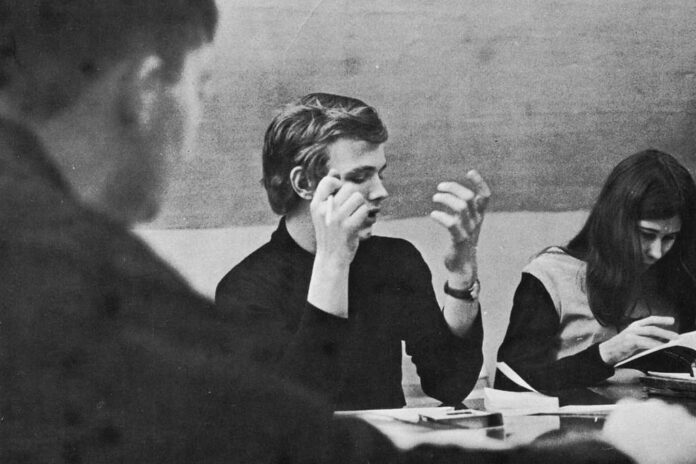
I have nobody left to talk to about my early years of teaching, which were both exhilarating and touched with a sense of failure. It was the ’60s, and I was involved with a group of faculty members in the creation of an innovative curriculum at CUNY’s first experimental and upper-division college, Richmond College. It was strangely and counterintuitively placed in Staten Island—the most conservative, both politically and culturally, of the five boroughs, and at that time mostly white and working class. It was not quite the best place to initiate courses in gay consciousness raising and feminist studies. But we attracted the more rebellious students, and I was unaware of the community gathering to tar and feather the faculty for supposedly brainwashing their sons and daughters.
While I am sure the college’s presence made some of the politicians and inhabitants of Staten Island uneasy, I did not think much of it then. My days were spent creating a curriculum and teaching what I thought would help build critical thinking and help the students see the world through the lens of the ’60s.
My courses were still linked to books and films and less wedded to personal experience than some of my colleagues’ offerings. Still, part of our innovative and alternative vision was built on reducing our power in the classroom and removing grades, except pass/fail as an incentive. In essence, we tried to create a less competitive and authority-grounded education. Utopian notions that worked at moments but often allowed students to neglect reading the assigned books or cut class to smoke weed or do something even less productive. We began with a fantasy that the classroom was an egalitarian place, that the professor had no knowledge, and that it was our responsibility and job to shape (with some input from them) what was to be learned.
The faculty was a varied group that included a gay, countercultural sociologist; an anthropologist with an interest in therapy; a Rogerian therapist; an older former Marxist who was our leader; a sociologist with an interest in performance art and “happenings”; two community psychologists; a very literary economist; a political scientist with a deep interest in philosophy and literature; and myself, a generalist with an interest in American culture, film, and literature. There were also a slew of interesting adjuncts—journalists, artists, and city planners. On paper, we had more intellectual authority than the students. Of course, that was nonsense; whatever our intellectual credentials, the students brought a raw urgency that no amount of academic authority could replicate.
Some of the faculty were committed to building community, others pursued their own research and writing careers at the expense of the program.
There was something too anarchic about the program, which could not be resolved within its short life, and the program was threatened by the economic pressures CUNY was facing at the time. Clearly, the need for some bureaucracy and hierarchy was necessary—I cannot see coherent reform without it. So, the experimental program was short lived, but the school remained loose and innovative and given to team teaching and interdisciplinary courses like “Politics and the Novel” and “The American Dream and Nightmare.” And in 1972 the college was one of only two schools on the East Coast that had a program leading to a degree in women’s studies.
That ’60s dream of creating an egalitarian, participatory, and student-centered curriculum never was sustained. But for a couple of years, I thought we were doing something unique. Still, its structure was flawed, and undermining tradition without fully working out a coherent alternative was doomed to failure.