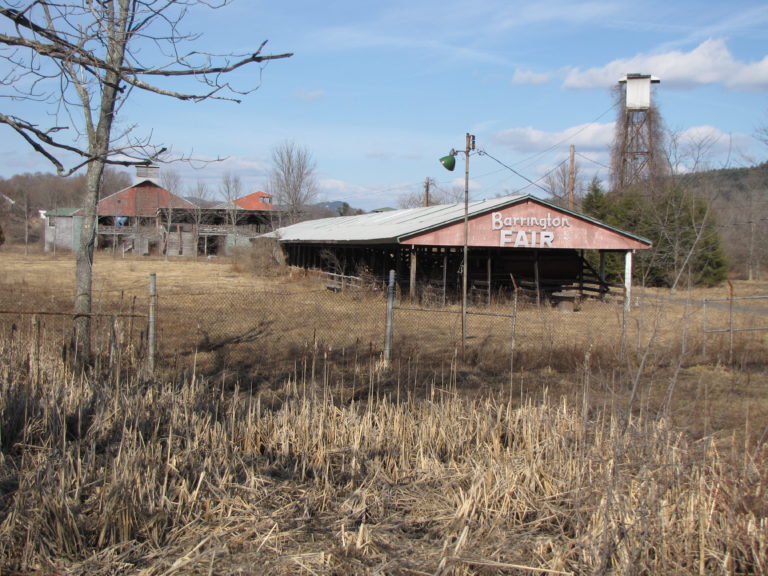
Much like the weather, everyone complains about the blighted Great Barrington Fairgrounds, but for years nothing has been done about it. The difference is that weather changes like the wind while the Fairgrounds has been in disrepair for a very long time. Inaction and the current owner won’t change that.
The good news is that Great Barrington has the necessary tool to hammer out the change we need, as long as it has the political will to wield it: eminent domain. Historically, eminent domain provided governments the ability to seize property for fair value for a public purpose, such as for roads, schools, and public utilities. Without eminent domain, the Massachusetts Turnpike is just a series of disconnected driveways.
Generally, eminent domain was not the domain of profit-seeking enterprise. One notable exception was the railroads, which were granted the right to exercise eminent domain to permit railroad network connections. But it is fair to say, until relatively recent legal developments, eminent domain was considered strictly for the public good rather than private enterprise.
In 2005, the U.S. Supreme Court held in the landmark Kelo v. New London decision that governments may exercise their right of eminent domain to transfer privately held land to a for-profit enterprise to revitalize a blighted area (although blight is not a prerequisite). While this was a landmark federal decision, the Court’s opinion merely reflected a growing body of state law.
Following the Kelo decision, many states enacted legislation to prevent municipalities from transferring public property to a private party with a for-profit motive. Forward-thinking Massachusetts has not done so, perhaps recognizing that the greater good sometimes requires a little private oomph.
With that in mind, let’s consider the Fairgrounds. I have been trying to get through all the accusations of dastardly deeds that have flown back and forth between the town and the Fairgrounds owner, and all I can confirm is that it would be easier to ferret out the facts behind all the Housewives of [pick a city of your choice] disputes. Suffice it to say, neither appears happy with the other, and, as a result, we are looking at long-term stasis. When children can’t play well together in a sandbox, you need to take them both out. What we have here is a very large sandbox.
Improving the Fairgrounds was much discussed back in 2021. Former Selectboard member Bill Cooke proposed a park with “a skating rink for wintertime, picnic tables—just a simple little park, if nothing else, and clean it up and knock down some of those dangerous buildings and make it look presentable for the southern end of town.” Revitalizing the Fairgrounds then became an issue in that year’s Selectboard election, with then-candidate/now-Selectboard member Garfield Reed proposing economic development: “I’m not an engineer, but if there is some way we could turn it into, say, an industrial park, maybe we could create some better-paying jobs.” One letter to the editor suggested that the Fairgrounds “may be the last viable property for a large not-so-central park for the town . . . [so] any viable alternatives that permit the parcel to remain open and undivided should be considered.” And like many debates, after the lights of the 2021 election went out, prospects for progress were dim.
The Fairgrounds is in a floodplain—not a suitable candidate for housing or an industrial park, but a terrific candidate for a park. The portion of the property adjacent to South Main Street (next to Barrington Bagel and across from Big Y) offers a developer a prime opportunity for a mixed-use development of retail space topped by low-occupancy residential space (low-occupancy due to floodplain limitations). Happily, Messrs. Cooke and Reed can both get what they want: a park for Mr. Cooke, a tax paying enterprise for Mr. Reed, and some much-needed housing for the rest of us. With the possible exception of the current Fairgrounds owner, everyone should consider this a win-win-win.
As we have seen in a couple of earlier Massachusetts endeavors (e.g., the nonprofit purchase of the Triplex and American Revolution), a group of citizens working together can effect change. Here, a group of individuals interested in improving our town can do so in just four easy steps:
- Development groups propose competing mixed-use redevelopment plans for the Fairgrounds to the Selectboard. Among other things, each development group agrees (1) to fund the cost of the fair market acquisition of the Fairgrounds; (2) to reimburse the town for any attorneys’ fees incurred; (3) to remove all structures; and (4) install fields, playgrounds, seasonal ice skating rink, etc. After soliciting the public’s input at public hearings, the Selectboard picks the best plan presented by the most financially viable group.
- Town Meeting approves the town’s exercise of its eminent domain authority to acquire for fair value the condemnable (but not condemned), dilapidated floodplain property (i.e., low-cost acquisition), and permits conveyance of title to the chosen development group upon satisfaction of all material conditions.
- Unless the parties wisely settle upfront, after a land court battle which the town will win but at a cost to both sides of attorneys’ fees and annoyance, the town exercises its eminent domain authority granted by the court, seizes the property, and agrees to convey title to the developer upon completion of the project.
- With greater personal guarantees and more favorable contractual rights than existed on the Powerhouse Square project, the development group creates a not-so-central park for everyone to enjoy and a beautiful commercial space topped by beautiful living space. Piece of cake.
I look forward to sharpening my ice skates … after I get some ice skates. For me, that will be the icing on the cake.