Maine lobsters have up and left for New Brunswick. Summer breezes come replete with imported Canadian ash. You can still buy apples at Bartlett’s Orchard, just not many grown at the orchard. (2023 has been referred to as the “Apple-Picking Apocalypse,” and we know that anything with -apocalypse or -gate in the title can’t be good.) Leaf-peeping season year after year “isn’t what it used to be” due to any combination of (1) it rained too much, (2) it rained too little, (3) it was too cold, and (4) it was too hot. It isn’t that it rains more, it is just that it seems like it rains constantly (and always on the weekend). Climate change has arrived at Great Barrington’s door. Great Barrington, let me introduce you to climate change.
Of course, climate change is not only a Great Barrington dilemma, but a global phenomenon: glaciers melting; rain forests burning (counterintuitive, right?); the Panama Canal lacking sufficient water to transit ships (water being, at its core, the essence of a canal). Suffice it to say, climate change is hard to ignore, unless you mine/burn coal, pump/dispense crude, or perceive it as a Democratic plot to undermine our God-fearing institutions.
I was tempted to pose the question “What does Great Barrington look like in a post-climate change world?” But that does a great disservice to climate change. It is climate changing, not change. There are currently no stops and no terminus on our climate change train. Think snowball effect, the meaning of which term future generations will simply not be able comprehend. So let’s consider, then, what Great Barrington looks like in a climate changing world. More to the point, what does Great Barrington’s service economy, founded in multi-season tourism, look like in our climate changing world?
Just as all politics is local, so is weather. We all suffer the consequences of climate change together, only each in our own way. I generally consider Great Barrington to thrive in three distinct seasons: summer arts season, fall leaf-peeping season, and winter ski season. (Yes, I have purposefully excluded spring mud season; feel free to tell me about the joys of mud in the comments section below.) Thus, it is interesting to consider if our climate changing world will improve or impair Great Barrington’s economy beyond the deleterious effects we will all endure. We know that shouting at the rain won’t make it stop, but we should at least consider if Great Barrington will despair if it does not.
The Berkshires have always been more temperate in summer than the Northeast’s concrete jungles, and nothing to date suggests that will change. What is likely to change is the attraction to the Northeast’s beach communities. Climatologists predict that climate change’s earliest victims will be in seashore communities—looking at you, Fire Island, Hamptons, Block Island, Martha’s Vineyard, Nantucket, and Cape Cod. Buying “forever homes” in these communities is likely to become less attractive and with a far shorter “forever” horizon. Against that backdrop, the Berkshires stand tall. Great Barrington’s milder climate, clean-ish air, and plentiful activities will look pretty good to vacationers with eroding options.
Everyone who has ever lived in Southern California, as I have, has had the misfortune of hearing someone propose buying property in Nevada as beachfront for after “the Big One.” While that comment never elicits as much as a smirk, it is hard to ignore that in a world where beaches are slowly disappearing, being in the hills has its advantages. This is not a suggestion that Great Barrington should seek to profit from other’s misfortune, just an acknowledgment that Great Barrington may be well situated. Of course, an argument could be made that an ad campaign with the tagline “The Berkshires—swim if you want, not if you must” could drive business to our bed and breakfasts, but some may find that distasteful. Let’s agree that the Berkshires will remain a garden spot. More rain/humidity than we might prefer, but being in Great Barrington surely beats the alternative. And by that I mean, everywhere else.
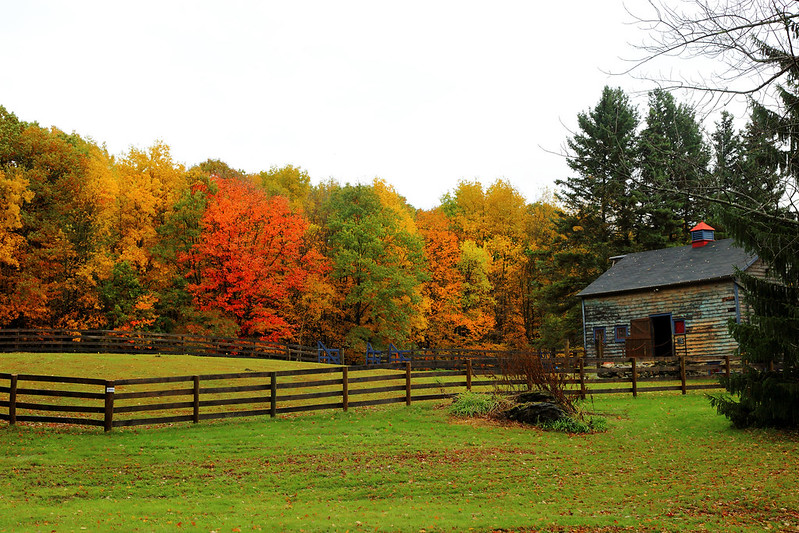
Fall is somewhat more problematic. If we can extrapolate from recent leaf-peeping seasons what the future holds in our climate changing world, it is not as red, orange, and yellow as we would like. Our tourist economy may suffer the same fate as Maine lobstermen when the thing we are trying to catch heads north, but I am firmly convinced being here will always be better than being there (if there is Boston/New York/Philadelphia/Washington, D.C/Miami). We may know that leaf-peeping seasons in the future will not be as grand as leaf-peeping seasons in the past, but we just need to sell each year the possibility of a glorious leaf-peeping season. There is always the prospect of a colorful season, even if the reality is not nearly as vibrant. And when the legend of our glorious leaf-peeping seasons becomes fact, we can advertise the legend.
It is our winter tourist season where I am most concerned. Just as canals need water, skiing needs snow. If recent winter weather events are prologue, we can expect larger but fewer snowstorms. Lots of dollops replaced with fewer heaps, which may melt with higher mean temperatures. Will skiers follow our lobsters and leaf peepers? Or will they be satisfied with heroic efforts to make snow? We will still have the Mahaiwe, the Triplex, Berkshire Theatre Group, Barrington Stage, and Shakespeare & Co. for those times that our snowstorms are a bit flaky.
Bottomline: Great Barrington may fare better than many tourist communities in our climate changing world. This is not to suggest that I hope Great Barrington profits from others’ significant despair, only an acknowledgment that, as with most things, there are bound to be winners and losers. Of course, this analysis must also recognize that there are too many unknown unknowns to accurately assess how any community makes it through the coming climate change storm. For now at least, Great Barrington’s future looks bright with a chance of rain.