Editor’s note: Besides tracking technological advancements and innovations, our author is a Juilliard-trained musical composer. He has created a musical piece titled “Crisis Affluence” for you to enjoy while reading this column.
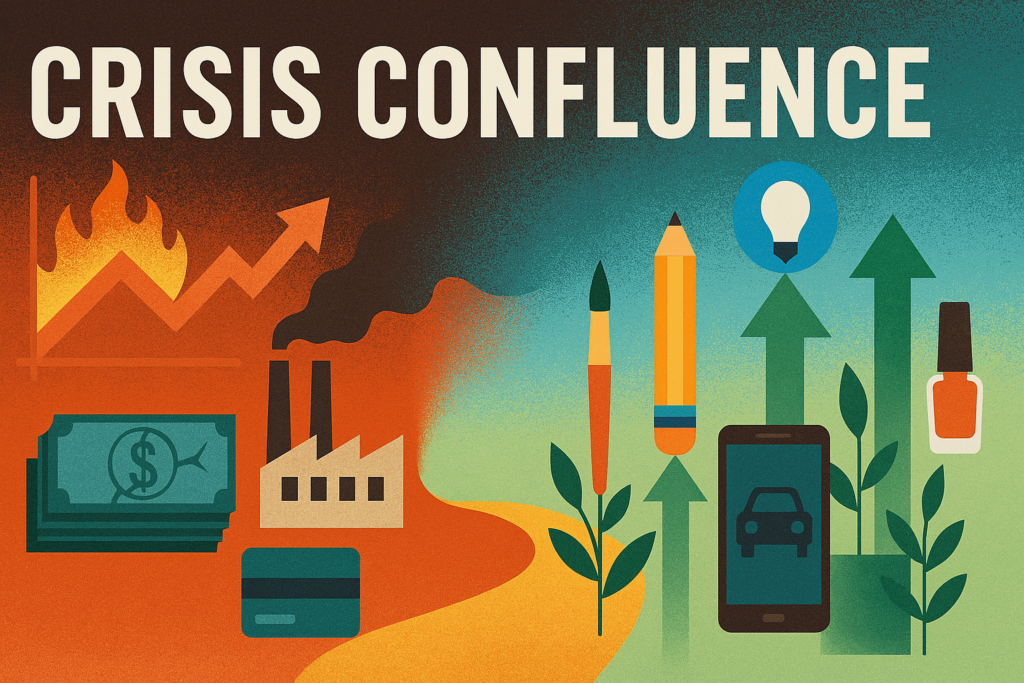
We tend to think of crises as periods of collapse, as chapters marked by loss and uncertainty. And they are. But they also have a strange way of dislodging what no longer works and creating space for the new. In the turbulence of an economic breakdown, the scaffolding of the old order often shakes loose just enough to let new ideas slip through. What once felt impossible becomes necessary, and what once had no audience suddenly finds one. A confluence occurs—not of comfort and ease, but of pressure and possibility.
During the Great Depression of the 1930s, most businesses tightened their belts or shut their doors. Yet a few curious minds saw not only despair but demand. In 1939, Bill Hewlett and Dave Packard started building audio oscillators in a Palo Alto garage. It was a modest operation, but it was the beginning of Hewlett-Packard and, arguably, the entire Silicon Valley story. That same decade, Revlon launched a single product—an opaque nail enamel that offered affordable glamour at a time when luxuries were hard to come by. These were not massive industrial bets. They were human responses to hardship, acts of invention rooted in empathy and practicality. By understanding what people needed when times were tough, these companies built foundations that outlasted the downturn and fueled future prosperity.
In the 1970s, amid an energy crisis, runaway inflation, and broad economic stagnation, another wave of opportunity quietly began. In 1975, two young programmers named Bill Gates and Paul Allen founded Microsoft, betting that personal computing would change everything. This wasn’t a safe bet in an era when computers were the size of refrigerators and owned mostly by large institutions. However, the backdrop of instability and change permitted them to believe that the future might look very different from the present. Their timing proved prophetic. As the old economy
stumbled, the digital economy began to form—one transistor at a time.

The late 1990s offered a different kind of upheaval. The dot-com boom was an explosion of possibility, but it collapsed just as fast. Many companies disappeared, but some weathered the storm and emerged stronger. Google was incorporated in 1998 and grew through the wreckage of the early 2000s with a laser focus on search quality and monetization through targeted ads. Amazon, founded in 1994, survived the dot-com bust and used the downturn to refine its logistics and customer experience. It became profitable in 2001 and never looked back. The dot-com bubble bursting cleared the field, allowing the few with durable value to become giants.
Then came 2008. The financial crisis gutted the housing market, shattered job security, and exposed deep flaws in the traditional economy. But again, gaps appeared. And into those gaps stepped a new wave of entrepreneurs who saw what had broken and what could be reimagined. Airbnb made use of spare rooms. Uber made use of idle cars. Stripe and Square made it easier for everyday people to accept payments and run small businesses without the burden of legacy infrastructure. These companies did not simply adapt to a new economy—they helped define it. And they did so quickly because economic crises compress time. Behaviors shift overnight. Risk tolerance rises. The impossible becomes plausible, and the implausible gets built.
By the time the COVID-19 pandemic struck, the world had already experienced multiple waves of crisis-born innovation. But even still, the pandemic created a sudden and widespread shock that entire industries flipped in a matter of weeks. Remote work went from fringe to default. Zoom became a household name overnight, not by inventing video conferencing but by making it simple and accessible when needed. Peloton, already a niche fitness brand, was at the center of a new reality where people could not go to gyms but still wanted community and movement. Once slowly gaining traction, telemedicine was suddenly the only safe option. Education shifted online. Mental health apps surged. The future was pulled forward by steady progress and shared emergency.
Crisis, then, is not just a force of destruction. It is also a catalyst. It strips away comfort but reveals urgency. It removes the unnecessary and spotlights what matters. It compels people to try things they might not have dared when the world felt more stable. That’s why so many transformative companies are born not in boom times but in busts. They respond to a new reality by retreating and stepping forward, often with less funding and more courage.
Interestingly, what gets built during a crisis often reflects a change in human behavior more than a technology change. The tools may already exist, but the willingness to use them shifts dramatically. A confluence forms from the collision of constraint, need, and boldness. What might have taken ten years to evolve instead takes ten months. What was once optional becomes essential.
Right now, AI seems optional, but it will drive incredible productivity increases. Will it also create some very serious displacement crisis? Absolutely. But it is not any worse than policies that do not make sense and peter out because they simply do not work.
Crisis confluence is not a theory; it is a recurring pattern. While no one wishes for hardship, it is worth remembering that constraint can breed creativity, that pressure can accelerate change, and that many of the most durable ideas emerge not during celebration but during recovery. When the storm clears, the landscape is different. Those who dared to build in the rain often stood on new ground.
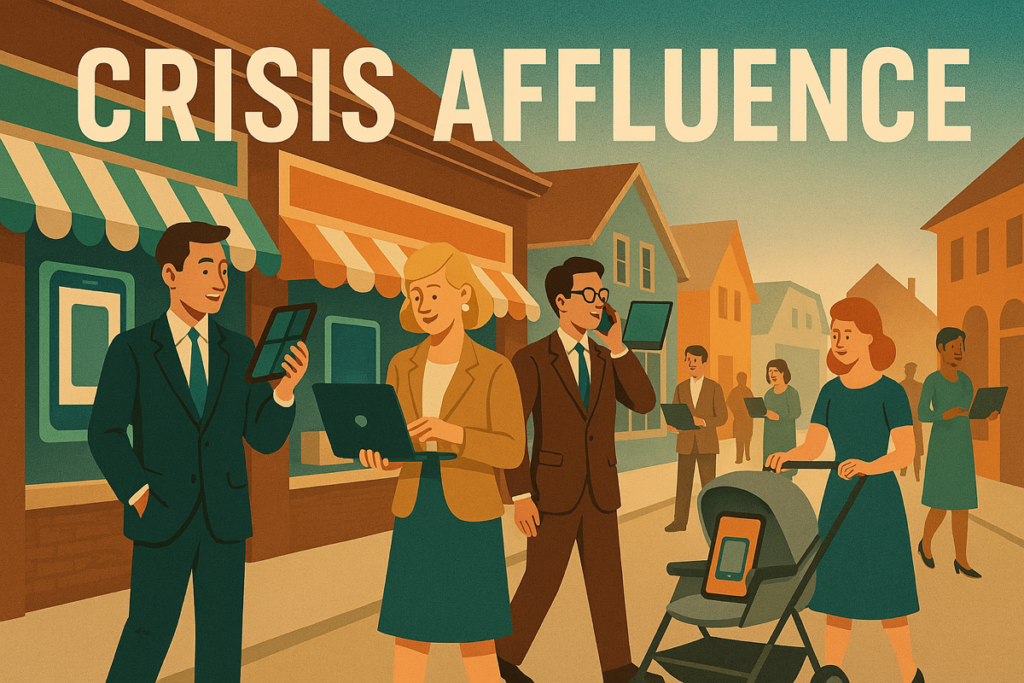
Crisis confluence does more than just spark ingenuity—it can also lay the groundwork for lasting affluence. When individuals and communities rise to meet the demands of a crisis with creative energy and practical invention, they often build entirely new economies. The same innovations that start as emergency measures can become engines of prosperity. What begins as a side hustle to weather a downturn may evolve into a thriving business. Technologies deployed in desperation can later be repurposed or refined into indispensable tools. The adaptive habits and bold experiments born in crisis moments don’t just help people survive—they position them to thrive in the new landscape that follows. Over time, these shifts compound. Whole towns, industries, and even countries can emerge from hardship not merely resilient but economically transformed, having turned adversity into an unexpected form of affluence.