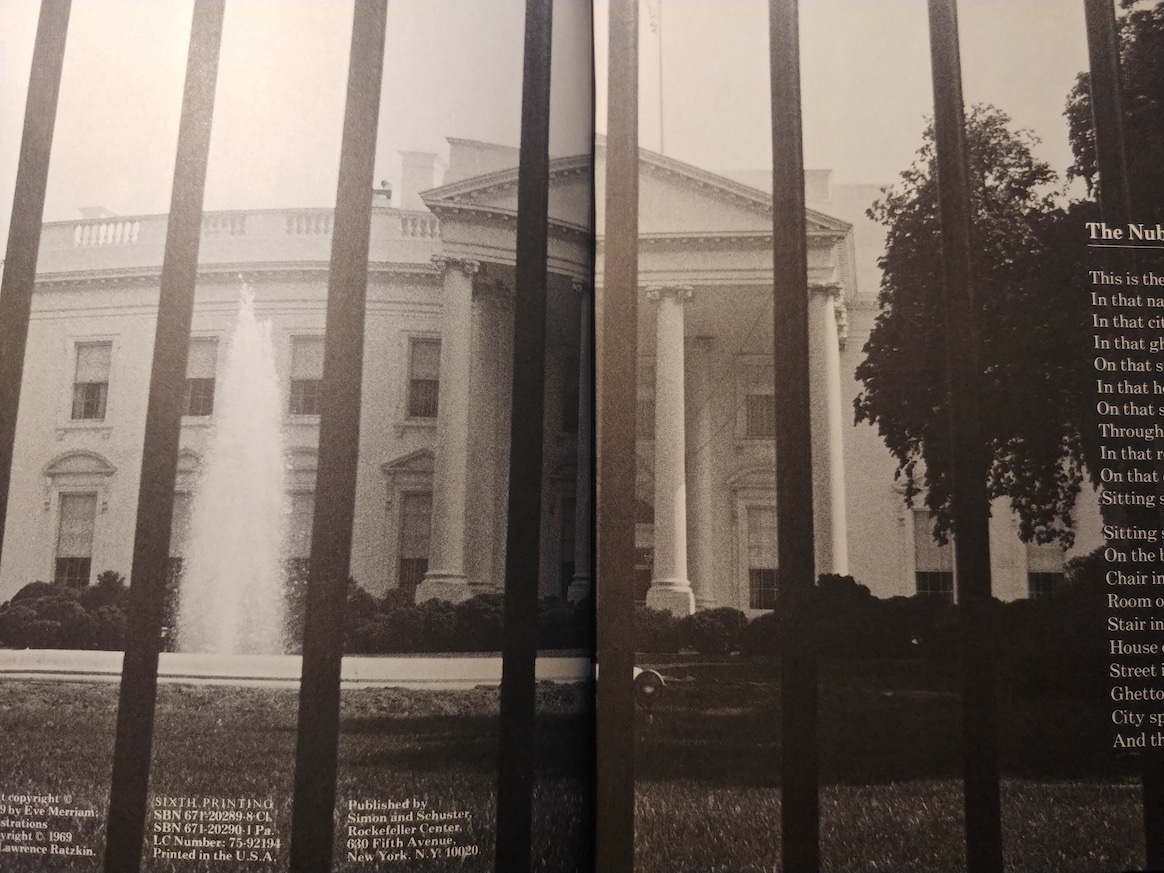
In 1969, as Richard Nixon took the reins of our country, the poet Eve Merriam was preparing for publication her book “The Inner City Mother Goose,” a collection of simple, poignant poems that addressed both classic topics and modern realities. A two-page introduction showed a photograph by illustrator Lawrence Ratzkin of the White House in Washington, D.C., as much an “inner city” view as one can get. At the center of the country’s capital, the house stood, as it stands today, as a bastion of American realities. Against it was the book’s opening poem, “The Nub of the Nation.” Nub: the crux or central point of a matter. The word applied then and now to that specific location as Americans see the White House and the duties and responsibilities of its occupant.
Here is the text of the poem, a poem that predicted the years to come, those Nixon years:
This is the nub of the nation:
In that nation is a city,
In that city is a ghetto,
In that ghetto is a street,
On that street there is a house,
In that house there is a stair
On that stair there is a door.
Through that door there waits a room.
In that room there is a chair,
On that chair there is a person
Sitting staring there.
Sitting staring there
On the broken chair,
Chair in the cockroach room,
Room on the worn-out stair,
Stair in the no-care house,
House on the drop-dead street,
Street in the ghetto rot,
Ghetto rooted in the city.
City spreading everywhere:
And this is the nub of the nation.
Who would have thought it could presage a time so far away as our time.
The poem takes on revitalized meaning now, after nearly four years of anti-philosophy in that White House by the current administration’s self-proclaimed occupant. In spite of, and in opposition to, any gilding of the room, it is the room that Merriam infers in her poem, a room ready to welcome a newly elected man who can put it all right again. The White House has stood as a symbol of all that’s right in our section of the world — that is, until now. Now it is the ghetto of the self-satisfied, the drop-dead center of a street already reconfigured into Black Lives Matter Plaza. Echoes of a ghetto ring in that name, but a name with hope and light held within 16 letters, preparing to shine forth with a message to all: The nub of our nation need not be dark, need not be rotting in front of our eyes. There is still time to restore the house, the street, the city, the nation to all its former international glory — that is, if we make the effort to right all the wrong decisions that haunt us.
Merriam’s wonderful book closes with yet another poignant Mother Goose parody: “There Was a Man.” Here it is:
There was a man of our town
And he was wondrous wise —
He moved away.
I hope not. I need her to be wrong this time. I want that man to stay around, to move in, pull out his hammer and nails, his pliers and paintbrush, and get to work quickly bringing us to a brighter, healthier and shinier future. It’s only what we deserve after four years of rot and grime and roaches on the broken stairs. I want a man to restore my soul along with the soul of the nation. Don’t you want that, too?